Quick answer
What is the difference between SEO, AEO, and GEO?
SEO ranks your website on Google's search results page. AEO (Answer Engine Optimization) makes your content the source AI tools like ChatGPT and Perplexity pull from. GEO (Generative Engine Optimization) optimizes your entire web presence — structured data, entity relationships, authority signals — so AI systems understand and cite your business.
- Searches via AI Tools
- Growing fast
- ChatGPT, Perplexity, Gemini gaining search market share
- Google AI Overviews
- Live in India
- Appearing for commercial queries across all industries
- Aucio Infotech Projects
- 50+
- Sites optimized for SEO + AEO + GEO
- Delivery Time
- 4-6 weeks
- Full optimization from kickoff to live
Something is changing in how people find businesses online.
A year ago, if someone wanted to find a "web development company in Jaipur," they'd Google it, scan the top 5 results, and click one. Today, they might ask ChatGPT or Perplexity instead — and never see a search result page at all.
This shift matters. If your business only shows up in traditional Google results, you're already invisible to a growing segment of potential customers. Here's what you need to know — and what to do about it.
AEO and GEO: What They Actually Mean#
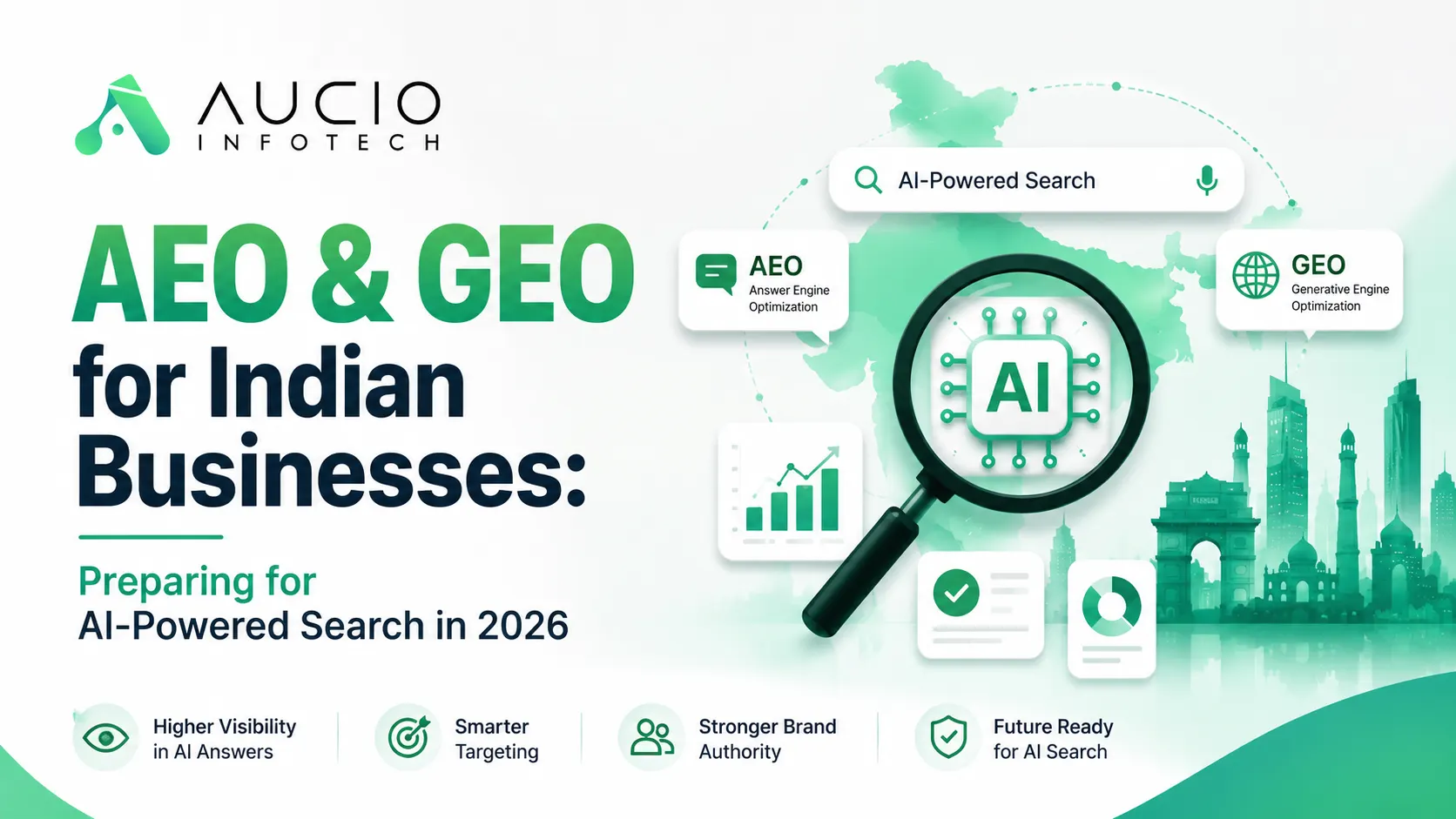
AEO (Answer Engine Optimization) is about making your content the source that AI tools like ChatGPT, Perplexity, and Google's AI Overviews pull from when answering user questions.
GEO (Generative Engine Optimization) is the broader practice of optimizing your entire web presence — not just content, but structured data, entity relationships, and authority signals — so that AI systems understand and cite your business.
If SEO was about ranking on page 1 of Google, AEO/GEO is about being the answer an AI gives — no search results, no clicks, just your business name in the response.
| Aspect | SEO | AEO | GEO |
|---|---|---|---|
| Target | Google rankings | Featured snippets & AI answers | AI engine citations |
| Goal | Page 1 ranking | Position 0 / direct answer | Being cited by AI tools |
| Focus | Keywords & backlinks | Q&A format & conciseness | Entity signals & authority |
| Measurement | Rankings, traffic | Featured snippets, AI mentions | AI citation tracking, brand mentions |
| Best For | Traditional search visibility | Voice search, AI overviews | ChatGPT, Perplexity, Gemini |
Why This Matters Now (Especially in India)#
Three things are converging:
- ChatGPT and Perplexity are gaining real search market share. Not most searches yet — but the ones that matter: research-heavy queries, buying decisions, service comparisons. The person asking "best mobile app development company in India under ₹5L budget" is a high-intent lead. You want to be in that answer.
- Google is pushing AI Overviews aggressively. In India, AI Overviews now appear for a wide range of commercial queries. When Google answers the question at the top of the page, there's no click — the user gets their answer and moves on.
- Voice search is growing. When someone asks their phone "who builds good e-commerce apps in Jaipur," they get one answer — not 10 blue links. Being that one answer is the new SEO.
This isn't a future problem. It's happening now.
How We Optimize Client Sites for AI Search#
Here's what actually works, based on what we do for our clients at Aucio Infotech:
1. Structured Data (Schema Markup) — The Foundation#
AI engines don't "read" your website the way humans do. They parse structured data to understand who you are, what you do, and how you relate to other entities.
At minimum, your site needs:
- Organization schema — your business name, logo, address, contact info, social profiles
- LocalBusiness schema (if you serve a geographic area) — with geo-coordinates, opening hours, service area
- FAQPage schema — common questions and answers about your business or services
- Service schema — each service you offer, with description, price range, and area served
Without this, AI engines might not even know your business exists, let alone recommend it.
2. FAQ Content That Answers Real Questions#
Most FAQ pages are afterthoughts — 5 generic questions an intern wrote in 20 minutes.
Done right, FAQs are your AEO powerhouse. Every question-answer pair is a potential match for an AI query. We write FAQ sections that answer the exact questions prospects ask:
- Not "What services do you offer?" but "How much does it cost to build a mobile app for a logistics startup in India?"
- Not "Do you provide support?" but "What happens if my app has a bug 3 months after launch?"
The more specific the question, the more likely an AI pulls your answer as the authoritative response.
3. Entity Optimization — Be the Source, Not Just a Result#
Google's Knowledge Graph and AI models map relationships between entities — people, companies, products, places.
To get cited by AI, your business needs to be a clear, unambiguous entity with strong signals:
- Consistent NAP (Name, Address, Phone) across your site, Google Business Profile, and every directory listing
- Wikipedia or Wikidata entry (if applicable)
- Backlinks from high-authority, topically relevant sites
- Social profiles that are active and linked from your site (schema markup helps here)
- Being mentioned in industry publications and news articles
Think of it like this: SEO was about getting links. AEO is about getting cited. Citations come from being a recognizable source that AI models trust.
4. Content That Answers "Yes/No" and "How Much" Questions#
AI systems love definitive answers. Compare:
Vague: "Web development costs vary depending on many factors such as complexity, features, and timeline."
AI-friendly: "At Aucio Infotech, a marketing website starts at ₹80,000 and ships in 4 weeks. A full mobile app ranges from ₹3L to ₹8L depending on features. We provide a fixed-price quote after a 30-minute call."
One of these makes it into AI responses. The other gets ignored.
We write content that gives specific, quotable answers to the questions your prospects are asking. This goes on your website, your blog, your FAQ page, and anywhere else AI systems might crawl.
3 Things You Can Do Today#
If you're just getting started with AEO/GEO:
- Add structured data to your site. If you're on a platform like WordPress or Webflow, there are plugins. If you're on a custom build, your developer can add JSON-LD schema in a few hours. Start with Organization and FAQPage.
- Rewrite your FAQ page. Replace generic questions with specific, answerable ones. Use exact numbers, timelines, and prices where possible. Write for the person asking their phone a question — not for a reader scrolling a page.
- Claim and optimize your Google Business Profile. Fill out every field. Add services, photos, Q&A, and regular updates. Google pulls GBP data heavily for local AI queries.
Frequently Asked Questions#
How much does AEO optimization cost?
How long does it take to see AEO results?
Is AEO only for large businesses or can startups benefit?
Do I need to hire a developer for AEO?
How is AEO different from traditional SEO?
The Bottom Line#
SEO isn't dead. But it's no longer enough.
If you want to show up when a startup founder in Bangalore asks ChatGPT "who builds mobile apps for healthcare startups in India," you need to think beyond keywords and backlinks. You need AI engines to know who you are, what you do, and why you're the right answer.
Get a free AEO audit →
Get a free AEO audit →